Yoooo! Peace fam.
This here is a topic i’ve been holding my tounge for a while on.
Waiting for the right time, place and audience to express it to.
But after long thoughts, I realized — there aint no better time than now.
Let’s talk about the real boogieman of the 2020’s… AI.
I recently read Linda Caroll’s Substack piece A Blunt Conversation About AI Writing and honestly I appreciated it. It’s one of the better conversations I’ve seen about AI writing from an actual human being thinking through it instead of just picking a side.
One part in particular really stuck with me. The part about the imaginary magic canvas and Van Gogh.
She wrote:
“That magic canvas made him wildly productive. He has twenty canvases lined up against the wall. And if he were to show them to people, most wouldn’t know.
A few might. But less than you think.
Here’s the amazing thing. Most people wouldn’t care. They wouldn’t. They’d say I don’t care how he created that, it speaks to me.”
That’s my favorite part of the article.
Because I think it reveals something important about art that we don’t always say out loud.
The process matters to the artist.
But the message matters to the audience.
Those two things are related, but they’re not the same thing.
Artists care deeply about process. Craft. Technique. Skill. Time spent learning the tool. Time spent suffering for the art.
But the audience usually just experiences the final feeling.
And if we lived in a world where process mattered more than the art itself… I honestly don’t know what art would look like.
Would we reject improvisation?
Would we reject songs made quickly?
Would we throw out half of Hip Hop?
Because if we’re being real for a second, Hip Hop has always played fast and loose with the idea of a “proper process.”
MC’s go in the booth and mumble sounds & melodies until something sticks.
Sometimes they punch in every other bar.
Sometimes they freestyle ideas with minimal preparation.
Sometimes it’s messy.
Sometimes it’s genius.
But we still call it music.
So what if we don’t like the process?
Does that make it inauthentic?
Well… can you hear it?
Then it’s real yo.
We’ve been through this before with other tools.
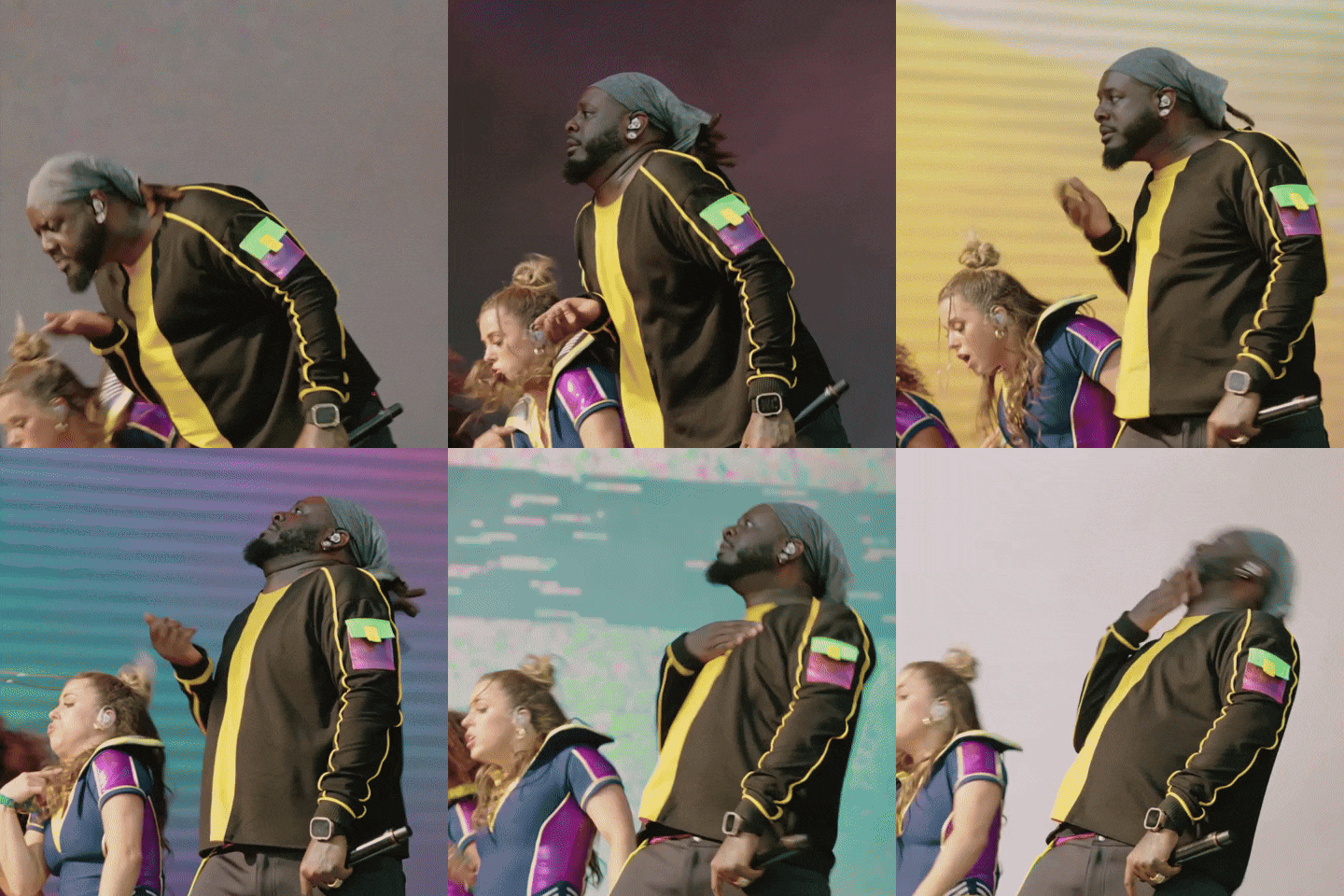
Folks literally shamed T-Pain for Auto-Tune. People acted like a robot made his music. Like the machine somehow erased the human behind it.
Meanwhile he was creating some of the most infectious sounds of that era.
To this day I consider T-Pain one of the most talented entertainers of our time. Auto-Tune is just one of the tools he uses — and uses extremely well.
Go listen to Epiphany. In my opinion it’s one of the best albums ever.
Auto-Tune didn’t create T-Pain.
T-Pain used Auto-Tune.
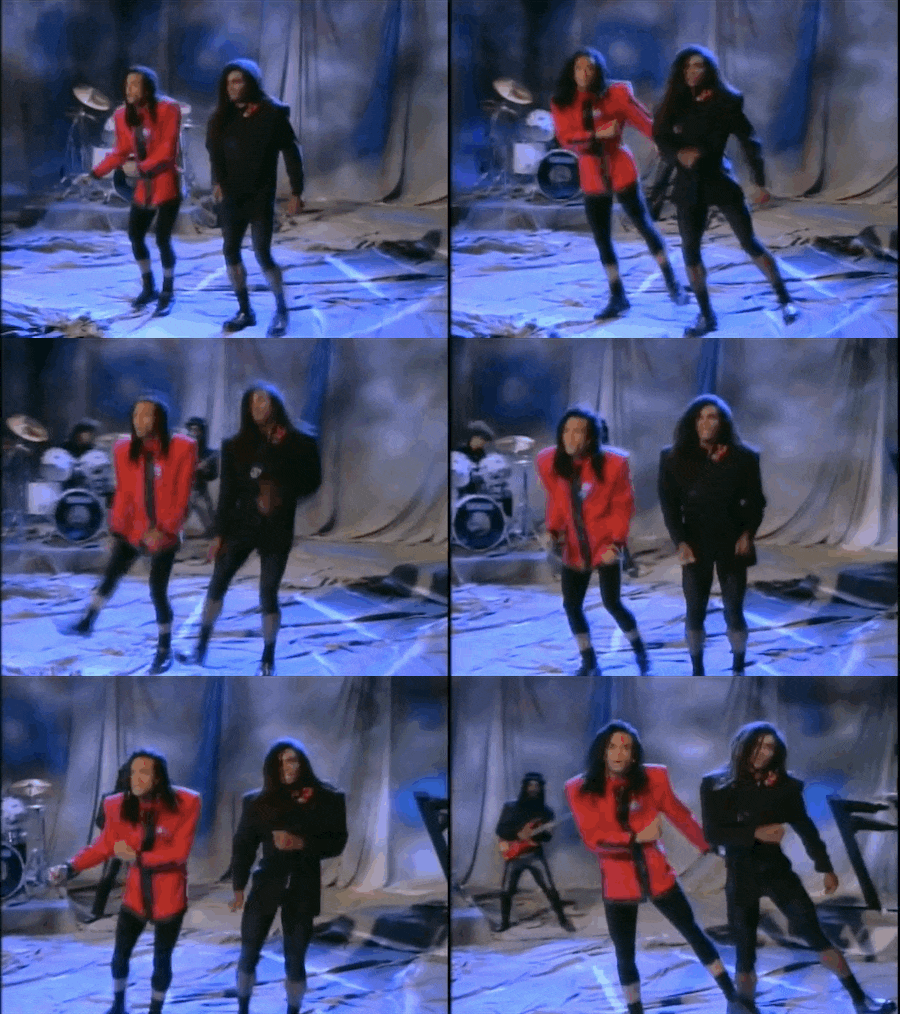
Same thing with Milli Vanilli.
Folks were mad mad at them. Even took their Grammy away.
In hindsight — I see nothing wrong.
They acted like their entertainment value disappeared overnight because they weren’t the ones singing.
But the truth is… they were entertaining. The songs were catchy. People enjoyed them.
I actually wish we could’ve seen that story go further. I still hit that arm-leg swinging dance to this day. It feels good. idc.
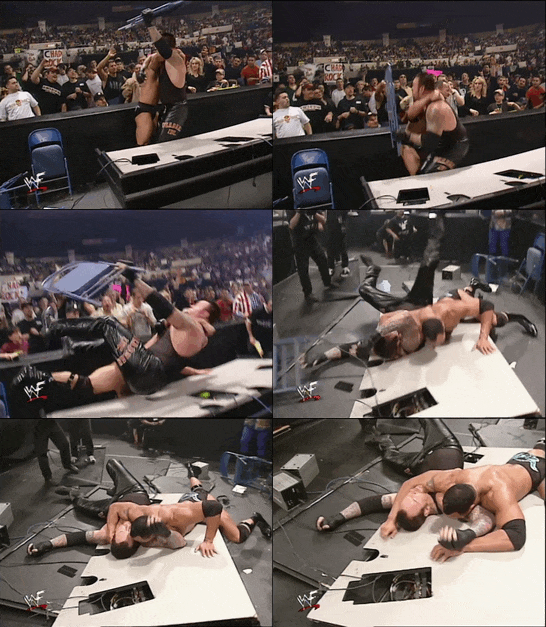
And don’t even get me started about another form of entertainment…
Folks literally watch professional wrestling.
We know those fights aren’t real.
We know those characters are exaggerated.
We know the whole thing is theatrical.
But we still enjoyed it.
We still smelled what The Rock was cooking…. knowing darn well that man don’t cook… *spoiler alert - he has a chef.
Entertainment and authenticity have always been more complicated than people pretend.
Hip Hop even has ghostwriters & ghost producers. It’s widely “not respected,” but you can’t tell me Dr. Dre didn’t snap on The Chronic albums.
I mean, pop music these days use a whole football team of writers for a 2.5 minute song.
These records still change culture. Still widley respected.
Which brings me back to AI.
Creatives are worried about Geneterative AI. And I get it yall.
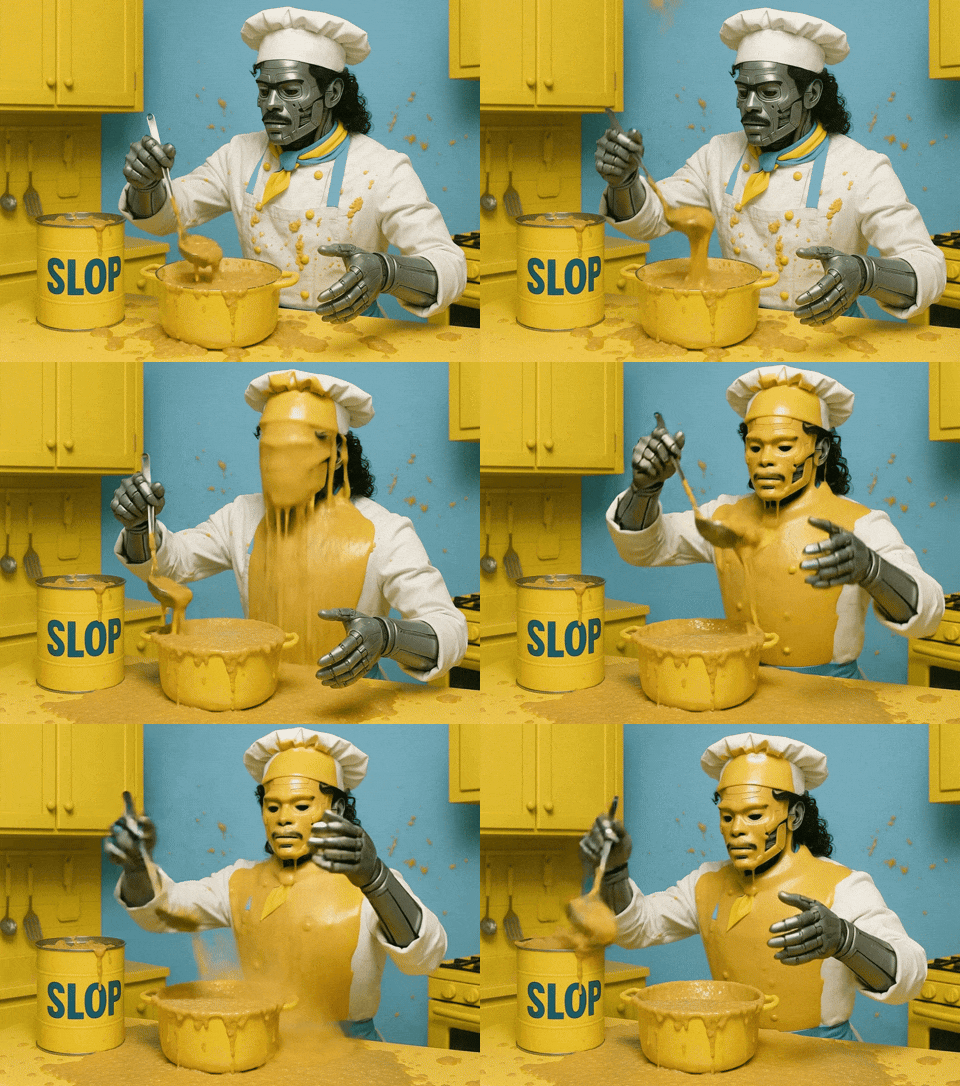
Some of it is definitely slop.
And yes — AI has a certain annoying style that you can start to recognize.
But we’ve had to deal with slop long before AI existed.
Bad writing existed before AI.
Generic music existed before AI.
Mass-produced art existed before AI.
The tool didn’t invent that.
Now here’s another part of Linda’s article that stood out to me:
“Many of the top Substacks are AI generated writing. In the AI report, Substack said of the 2000+ Substacks they reviewed, 70% are paid and roughly half are AI. People are paying for AI generated writing. Because it speaks to them.”
That’s interesting.
Because people are literally paying for writing that uses AI tools.
Why?
Same reason folks pay for the AI tool itself.
Because it speaks to them.
Now personally, I still feel like my work is human-made even when I use AI tools.
Because the ideas start with me.
The thoughts start with me.
The words start with me… and they always end with me.
Sometimes the tool just helps organize them into a readable sentence.
And honestly, tools have always existed in art.
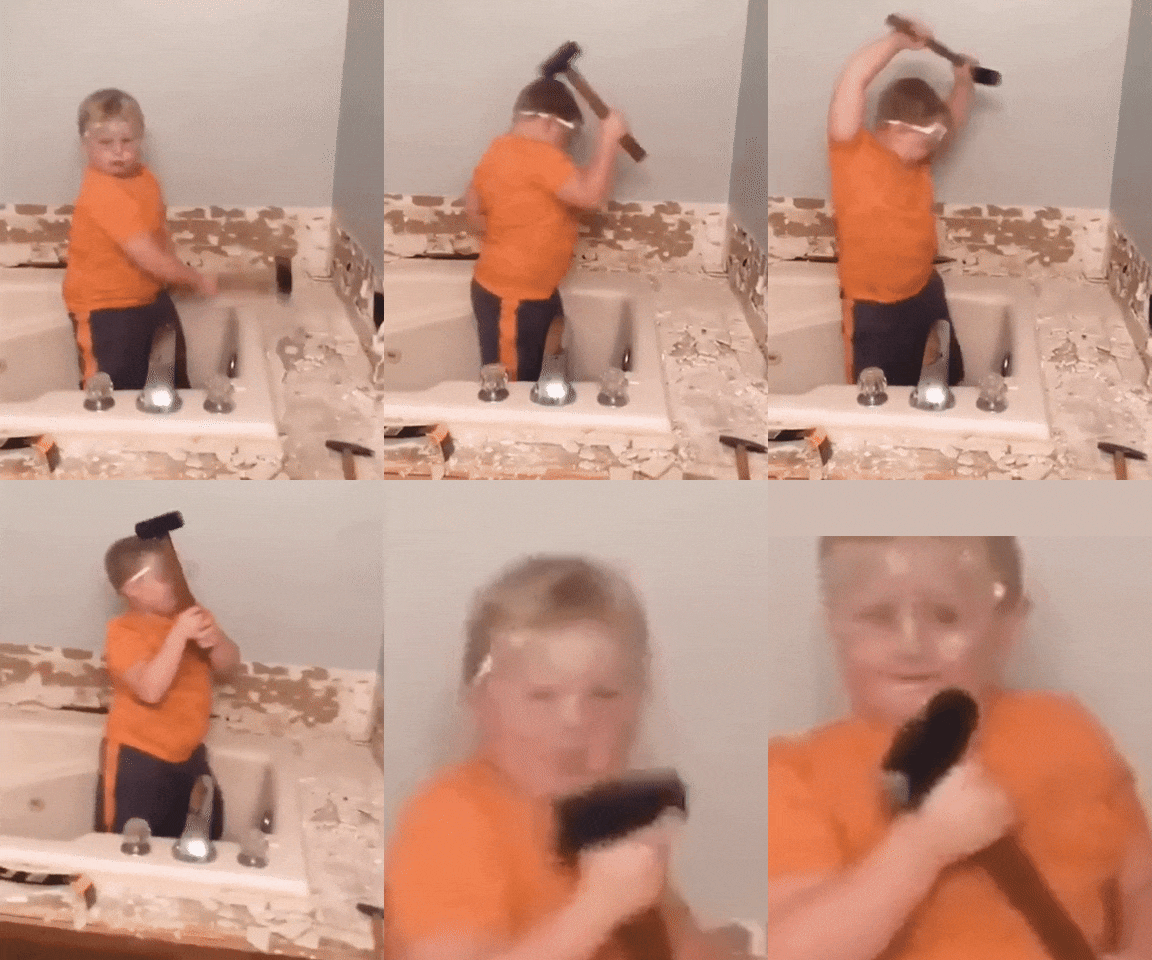
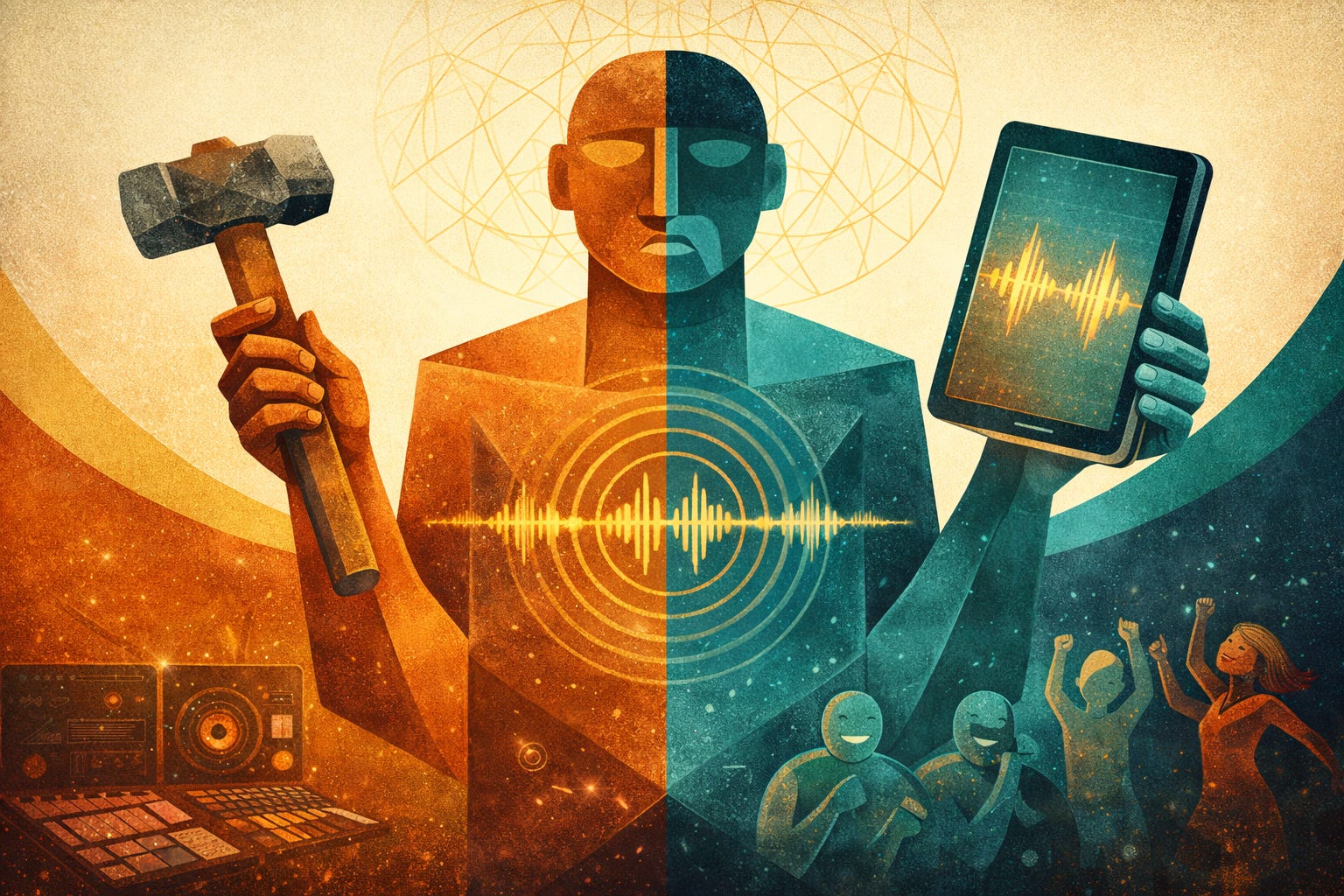
I like to think about it like a hammer.
Before the hammer existed as we know it, people were already building things. The earliest “hammer” was basically just a stone someone picked up and used to strike something else. Archaeologists have found those kinds of tools going back over three million years. Before shaped tools, people were literally just grabbing rocks and using their hands, striking stone against stone, bone against bone, figuring it out through trial and error.
Eventually those stones got attached to wooden handles. That gave people more leverage, more control, more power. Later came metal heads, iron, steel. Each step made the hammer more efficient.
But every improvement also made it more dangerous.
A rock in your hand can seriously hurt someone.
A hammer with a wooden handle can do real damage.
A forged steel hammer can break yo bones.
Same tool.
Just more refined.
But at the same time those same improvements built homes, temples, bridges, cities. Entire civilizations were literally hammered into existence.
So when I think about AI, I see something similar. A tool evolving. Getting stronger. Getting faster. Getting more capable.
Before the hammer existed, people built houses without it.
That took a certain level of skill. A certain level of craftsmanship. Some people probably considered that method more authentic.
But once the hammer existed, it helped people build faster. Better. More efficiently.
And look how much society progressed because of that tool.
But also let’s be real — the hammer has probably knocked a lot of people out too.
Same tool.
Two different outcomes.
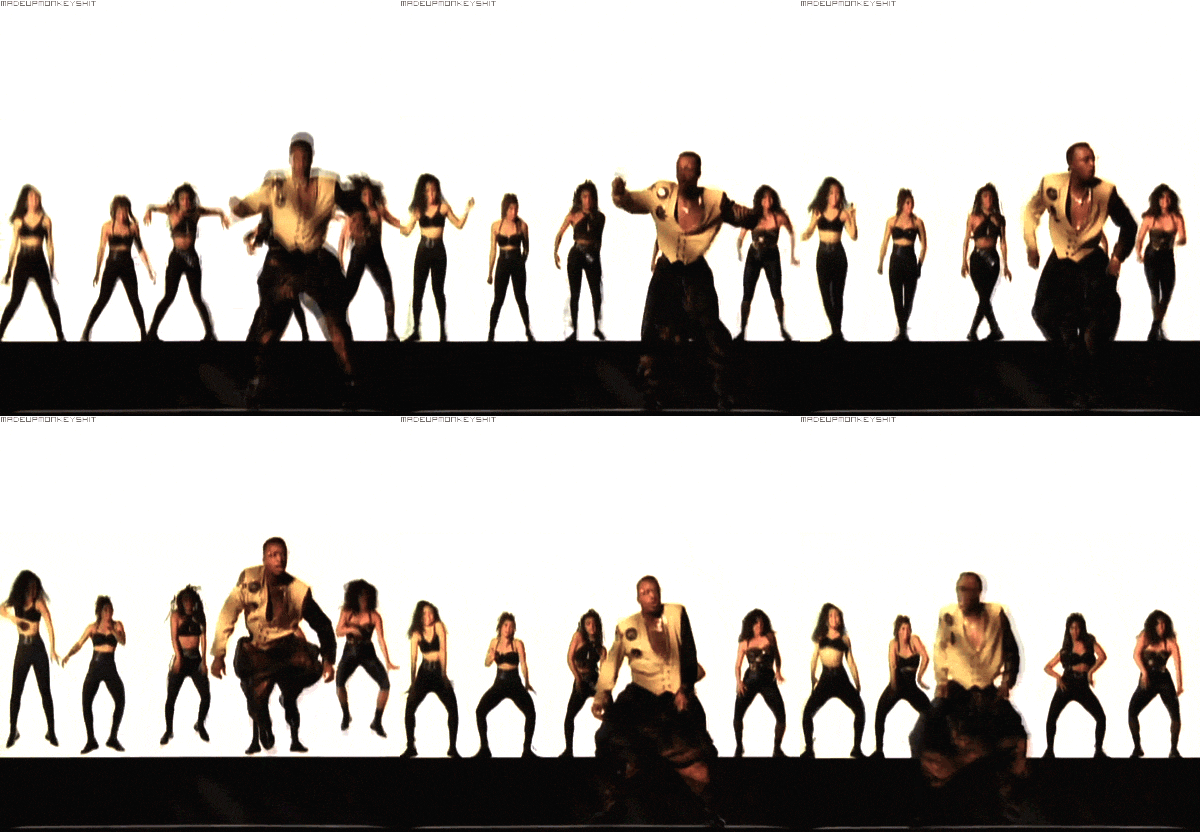
That’s how I look at AI.
It can build something meaningful.
Or it can be used lazily.
But that responsibility belongs to the person using it, and the compainies designing it.
People also bring up the argument that AI is trained on copyrighted material.
It is.
But if we’re being honest, humans are too.
Every writer learned by reading other writers.
Every musician learned by listening to other musicians.
Hip-hop literally built a culture around sampling.
Some of the best mixtapes are made up of stolen borrowed beats.
When an idea enters the world, it becomes part of the creative ecosystem.
That doesn’t mean copying it directly is okay. That’s still infringement yo.
But influence, inspiration, and remixing ideas has always been how culture evolves.
So when I think about AI in creativity, I’m not really interested in protesting its existence.
And I’m not interested in telling people they can’t use it.
I agree with Linda on this part.
I don’t want to live in a world where we aren’t free to make choices.
All I really care about is this:
Make something worth consuming.
Make something honest.
Because whether you’re using a pen, a sampler, Auto-Tune, a ghostwriter, or an AI tool…
The process may matter to the artist.
But the message is what the audience carries home.
And this is the part that keeps bringing me back to the same thought.
No matter how “artificial” the process might look from the outside, you can’t fake a human response.
Sounds carry real vibrations.
If a video made with AI made you laugh… guess what — the laugh is real.
If a song created with AI made you bob your head… guess what — that knock is real. Be careful…You still might actually break yo neck.
You can debate the process all day. You can debate the tool. You can debate the ethics, the craft, the purity of the workflow.
But you cannot debate someone else’s lived experience of resonance.
If something moved them, then it moved them.
There’s actually research that talks about the idea of artificial vibration — the concept that vibration can be generated mechanically or artificially. That part is true.
But the human response to vibration is not artificial.
The nervous system doesn’t fake its reaction.
Emotion doesn’t fake its reaction.
Your body doesn’t fake its reaction.
So if something made you laugh, smile, cry, dance, reflect, or feel seen — that experience is real.
And nobody can tell you otherwise.
You can critique the process all you want.
But don’t tell someone their experience wasn’t real.
Because if I laughed, I laughed.
If I felt something, I felt something.
And if a rhythm made me move…
Then that rhythm was real enough.
-Gold
Grand Vibrational Design is a reader-supported publication. To receive new posts and support my work, consider becoming a free or paid subscriber.